
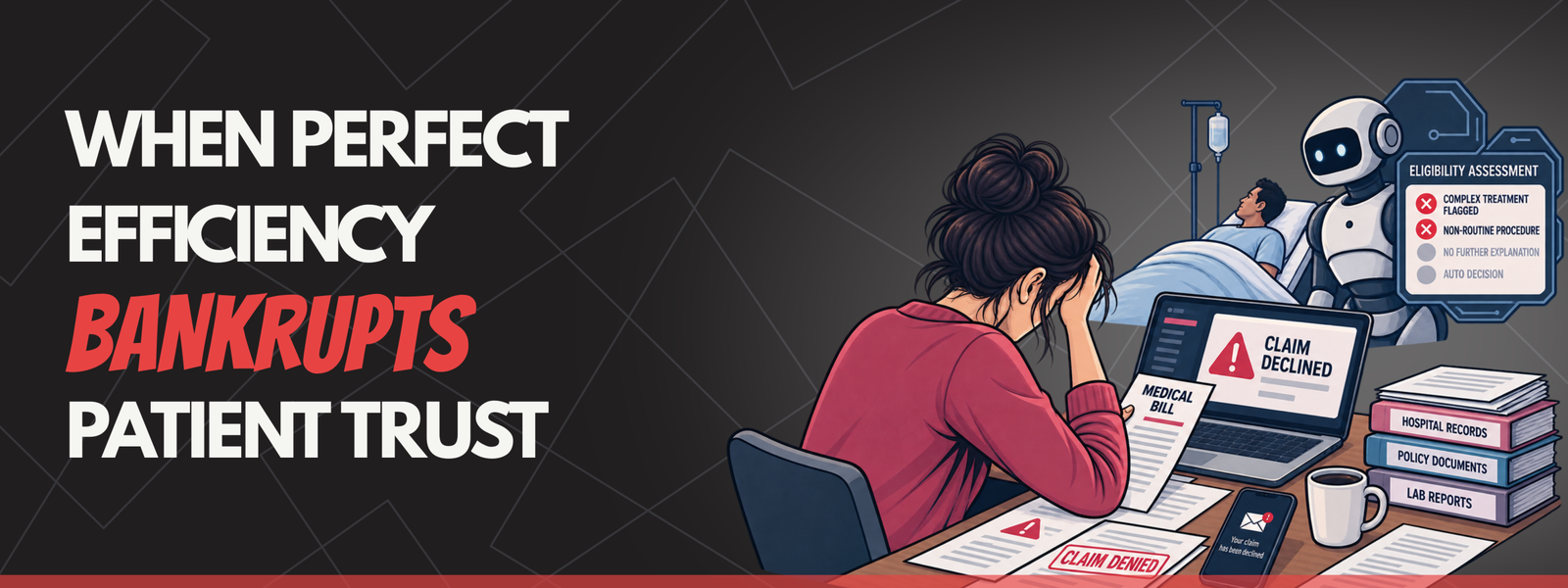
A family survived a major surgery only to face financial ruin because a new software update automatically flagged their legitimate claim.
The physical survival was a success. The financial nightmare is just beginning.
Sarah sits at the dining table, organizing a massive stack of medical bills while her husband rests upstairs after a major surgery. She has taken over the family finances, ensuring every hospital record is attached and every supporting document is complete.
They have maintained this exact health coverage for many years. The policy is active. The premiums are paid in full.
She submits the electronic claim, expecting a routine reimbursement within days.
Instead, her inbox chimes with a cold notification. Her claim is declined based on an eligibility assessment. The message provides absolutely no further explanation.
Frustrated and financially stressed, she calls the insurer. The support agent pulls up the file, which was processed by their newly deployed AI powered claims processing system.
The agent is completely locked out of the logic, offering the only generic explanation available on their screen. “The system determined that the claim did not meet approval criteria”.
The Digital Transformation Trap
How does a fully documented, life saving procedure instantly turn into a financial catastrophe?
The insurer had recently launched a massive digital transformation initiative. Drowning in manual paperwork and pressured to cut operational costs, they replaced human adjusters with an automated assessment engine.
The boardroom was thrilled with the initial metrics. Processing times plummeted, and operational productivity skyrocketed.
But here is the uncomfortable truth: the AI did not malfunction by denying Sarah. It operated flawlessly against a biased baseline.
The system was trained using historical claims data. Instead of just spotting fraud, it absorbed past human inconsistencies, learning to routinely flag complex treatments as suspicious.
The company was obsessed with measuring processing speed and fraud reduction. They practically ignored false denial rates and the resulting human collateral damage.
“An AI system that optimizes for speed while denying legitimate medical claims does not innovate. It simply automates a breach of trust.”
Breaking the Pattern
To stop digital transformation from becoming a reputational liability, insurers must embed structural accountability across the AI lifecycle:
- Before Deployment: An algorithm does not invent new rules; it weaponizes your historical inconsistencies. Insurers must execute a strict historical claims bias assessment before a model goes live. If you cannot prove explainability in a controlled environment, do not unleash it on your policyholders.
- During Deployment: Speed is useless if it creates an operational nightmare of escalations. Insurers must embed explainable AI capabilities directly into the customer support workflow. Furthermore, strict human review thresholds must be hardwired for high impact claims. A machine should never have the final, uncontested authority to deny a major medical payout.
- After Deployment: A deployed model is a decaying model. As medical billing codes shift, AI accuracy drifts. Organizations must launch continuous false denial audits and systematically track appeal outcome reviews. If customer complaint analytics spike, it must immediately trigger a mandatory model recalibration.
The Uncomfortable Truth
The ultimate objective of insurance is to provide financial protection during moments of vulnerability. Operational efficiency alone cannot be the primary measure of success.
When consequential healthcare decisions are handed over to algorithms, human judgement is not eliminated. It just makes a lack of empathy invisible.
We blame the algorithm for being heartless. But the machine simply delivered the exact level of care the institution optimized for.
This blog is part of a series of real world missing “Responsible AI” stories. We believe understanding what was missing is the first step to building it right.