
When e-commerce platforms optimize solely for maximum willingness to pay, personalized pricing degrades into an automated penalty on brand loyalty.
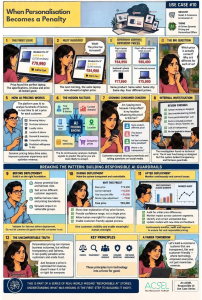
Priya is ready to buy her new laptop, but the price just jumped from ₹79,990 to ₹84,990 overnight.
Confused, she checks from three other devices. Her office computer says ₹80,490. Her husband sees ₹77,990. Her son logs in and finds ₹75,990.
Same product, same seller, same minute.
Now it is no longer just about getting a deal. Priya feels completely manipulated. She immediately calls customer support to demand an explanation for the hidden price tiers.
“Prices fluctuate automatically based on real time market conditions,” the support agent explains smoothly.
“But my family is looking at four different prices right now,” Priya replies. “Are you charging me more just because I shop here constantly?”
The agent pauses, staring helplessly at a locked pricing dashboard.
“The system generates individual offers, and I have absolutely no way to manually override your final number,” the agent admits quietly.
The representative cannot explain the variables behind the personalized markup. She possesses no authority to honor the lowest price.
The Optimization Trap
To the retail analysts monitoring the dashboards, the new dynamic pricing engine looked like an absolute triumph.
Conversion rates were climbing and average order values were steadily increasing. The technology successfully predicted exactly how much each customer was willing to pay before they abandoned their cart.
The tragedy is that the software possessed no concept of customer loyalty or market fairness.
The model was ruthlessly trained to optimize revenue based on deep behavioral profiles and past purchase history. It learned that frequent shoppers were less sensitive to sudden markups and quietly charged them a premium.
The business asked the machine to maximize immediate profit, completely ignoring that the algorithm would achieve this by secretly penalizing their most dedicated buyers.
When a retailer optimizes solely for maximum willingness to pay, it stops serving the customer and quietly transforms personalization into an automated loyalty penalty.
Breaking the Pattern
Before Deployment
- Test for Exploitation: Execute strict fairness testing across different customer segments before launching a dynamic model. If your data naturally penalizes repeat buyers, fix the logic first.
- Set the Boundary: Establish hard limits on price variance to maintain market integrity. Do not allow a machine to arbitrarily extract higher profit margins from your most dedicated shoppers.
During Deployment
- Demystify the Surge: Provide customer support teams with transparent explainability dashboards. Representatives must understand exactly which behavioral variables triggered a sudden price increase.
- Empower the Agent: Give human support representatives the immediate authority to override the algorithmic price and honor the lowest displayed offer.
After Deployment
- Measure Customer Trust: Continuously evaluate pricing consistency and perceived fairness just as ruthlessly as you track daily revenue.
- Halt the Penalty: Force an immediate model adjustment the moment the system begins systematically overcharging specific demographic groups.
The Uncomfortable Truth
The ultimate objective of retail is to build lasting customer relationships founded on confidence. Operational scale and maximized profit margins alone can never be the only metrics of success.
When we surrender dynamic market value to automated prediction loops, we make the slow erosion of consumer trust completely invisible.
The machine is not to blame for the unfair price variation. The true failure happens the exact moment a business decides that a customer’s loyalty is just another vulnerability to be financially exploited.
This blog is part of a series of real world missing “Responsible AI” stories. We believe understanding what was missing is the first step to building it right.