
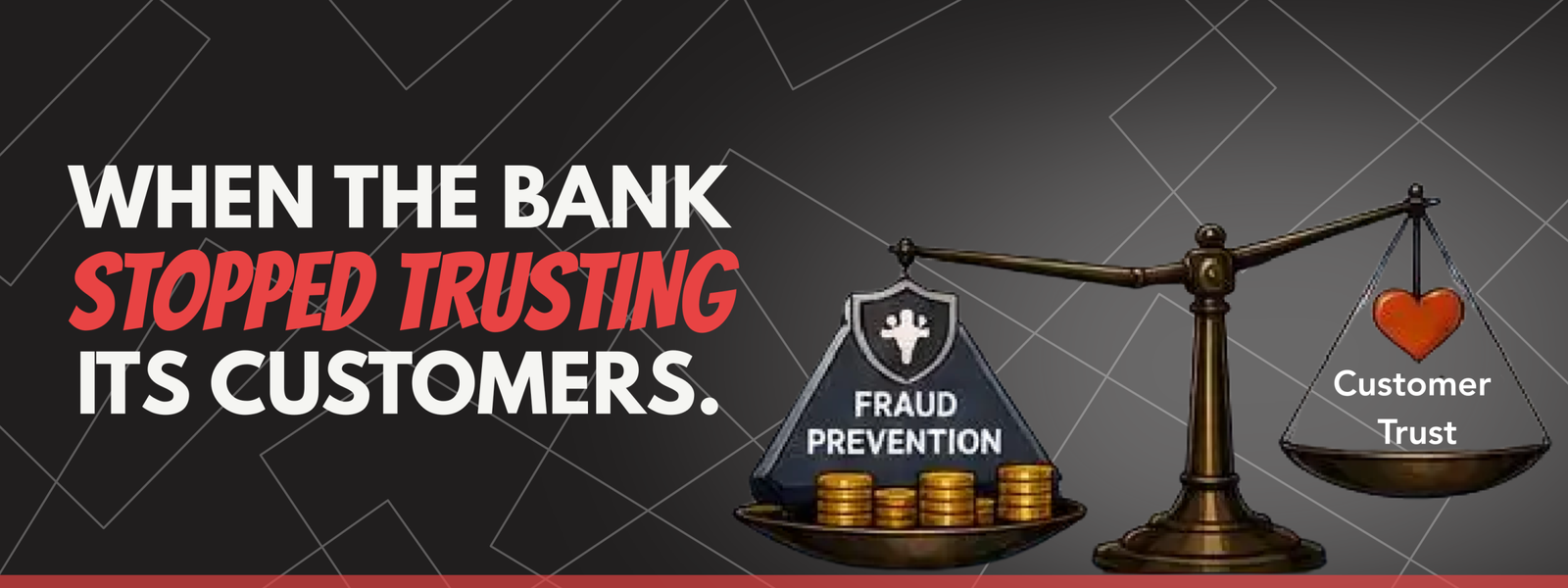
A loyal customer found herself completely stranded abroad after an aggressively tuned security system decided her urgency was a threat.
The boarding announcement echoes through the departure hall. “Final call.”
Priya is minutes away from missing her connection. She is standing at a foreign transfer desk at 2:00 AM, frantically swiping her card for an unexpected flight change.
Her card is valid. Her account balance is sufficient. She has banked with this institution for years.
She swipes. Declined.
She tries again. Declined.
A third attempt. Declined.
Her phone buzzes. A sterile text message informs her that unusual activity has been detected. Her entire account is now temporarily restricted for security reasons.
Stranded in a foreign country with zero access to her own money, she frantically calls customer support. The representative is polite but entirely helpless.
The AI driven fraud detection system flagged the transaction, but the screen offers no explanation. The machine has spoken. The human is left reading a script: “The system has identified potential fraud risk”.
The Optimization Trap
How does a frantic card swipe in a new time zone instantly turn a loyal customer into a critical security threat?
To understand the context, we have to look at what the bank was celebrating behind closed doors. Facing rapidly growing transaction volumes and mounting fraud losses, the institution unleashed an advanced AI driven detection engine.
By all internal metrics, it was a resounding triumph. Fraud prevention improved significantly, and losses began declining. Security teams celebrated the results.
But here is the uncomfortable truth: the AI did not malfunction by blocking Priya. It worked exactly as designed. The bank had configured the fraud risk thresholds aggressively to maximize prevention. It viewed any sudden deviation from normal behavior as a threat. The failure was a catastrophic flaw in measurement.
The institution focused entirely on predictive accuracy, treating false positive rates as acceptable collateral damage. Legitimate transactions, like urgent travel or healthcare payments, were swept up in a paranoid digital dragnet.
They measured the money saved. They completely forgot to measure the trust lost.
“An AI system that blocks every suspicious transaction may reduce fraud losses, but if it also disrupts legitimate customers, damages trust, and creates governance concerns, the organization has merely exchanged one risk for another.”
Breaking the Pattern: The Missing Guardrails
To ensure algorithms do not blindly scale our paranoia, we must implement robust guardrails across every phase of the AI lifecycle:
- Before Deployment: We cannot fix in production what was broken during setup. Security cannot operate in a vacuum. Organizations must conduct rigorous false positive impact assessments and properly calibrate fraud risk thresholds before a system ever goes live.
- During Deployment: Operational efficiency should never eliminate human empathy. Systems require explainable AI mechanisms so that stranded customers are never given a cold, robotic rejection. Furthermore, banks must mandate human review thresholds for high impact actions, ensuring a person can intervene before an account is entirely frozen.
- After Deployment: AI is never truly “finished”. Models degrade and travel behaviors shift. Continuous monitoring must evaluate customer complaint analytics and utilize continuous false positive audits just as closely as it evaluates stopped transactions.
The Uncomfortable Truth
The ultimate objective of a financial institution is not simply to stop fraud. The objective is to stop fraud while preserving customer trust.
When we give consequential decisions like financial access to algorithms, we do not eliminate human judgement. We just make it invisible.
The machine did not fail Priya at the airport. The flawed metrics the bank gave it did.